Special Lecture Series by Faculty Members of the University of Tsukuba, Malaysia (UTMy)~Vol.3 Professor Dr. HIRAISHI Noriko, Professor of the University of Tsukuba and the UTMy
2026/7/30
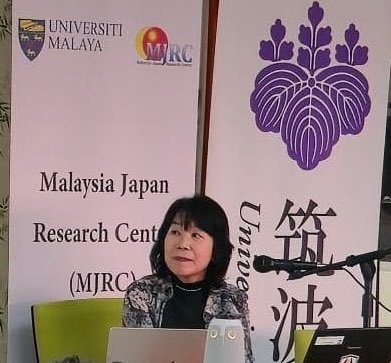
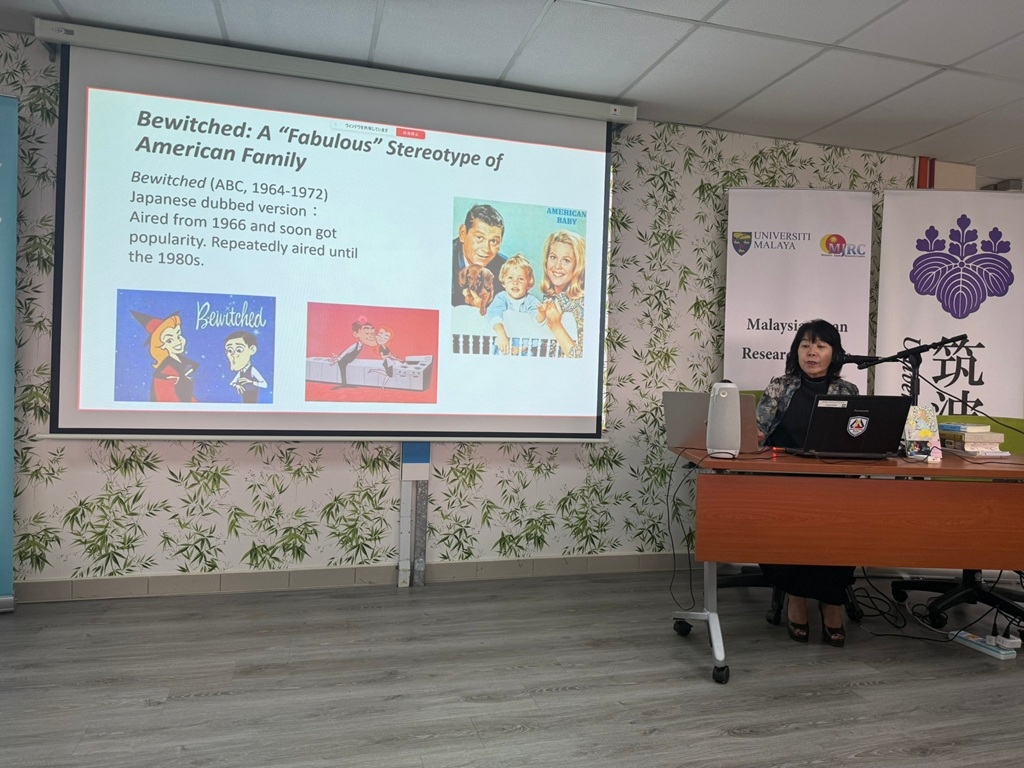
The Embassy of Japan in Malaysia, in cooperation with the University of Tsukuba Malaysia (UTMy), is holding a special lecture series by UTMy faculty members. As the third lecture in this series, on 28 July, the Embassy held a special lecture at the Malaysia-Japan Research Centre (MJRC), Universiti Malaya, by Professor Dr. HIRAISHI Noriko, Professor of the University of Tsukuba and UTMy.
The first and second lectures in this series focused on science-related fields. For this third lecture, the series featured its first lecture in humanities, delivered by Professor HIRAISHI, whose area of expertise is comparative literature.
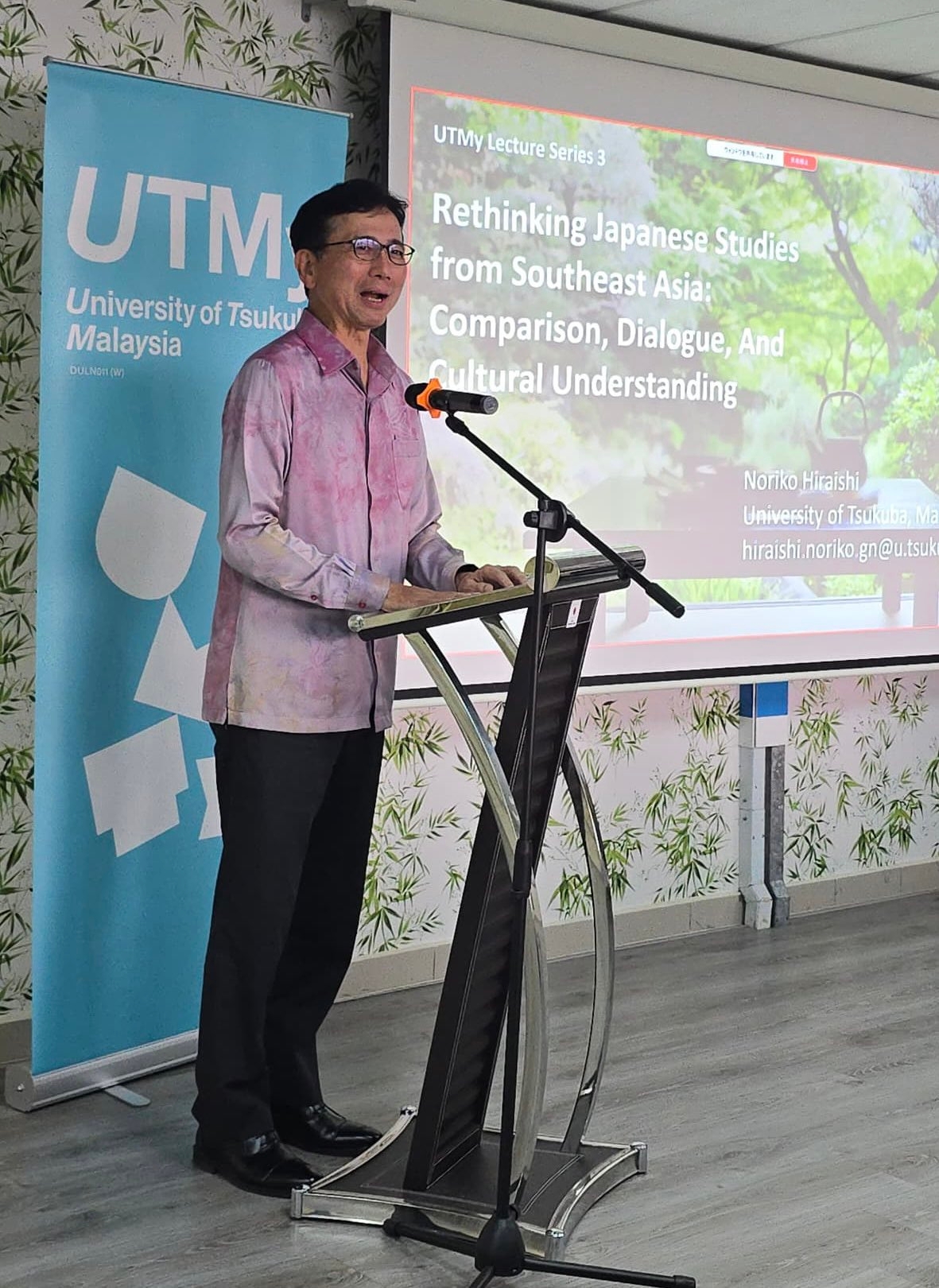
Under the title “Rethinking Japanese Studies from Southeast Asia: Comparison, Dialogue, and Cultural Understanding,” Professor HIRAISHI explained that studying Japan from Southeast Asia does not simply mean adding a regional perspective to Japanese Studies. Rather, it can provide an opportunity to reconsider what kinds of questions are asked in Japanese Studies and from what position those questions are posed.
Professor HIRAISHI described comparative literature not merely as the comparison of two works placed side by side, but as a method of “dialogue” through which meaning is created when different readers, histories, societies, languages, and cultural memories encounter one another.
In the lecture, she discussed examples including EKUNI Kaori’s short story “Melon,” MATSUMOTO Seicho’s Atsui Kinu (Hot Silk), ARISUGAWA Alice’s The Mystery of the Malayan Railway, Tan Twan Eng’s The Garden of Evening Mists, and the Webtoon version of the Indonesian female hero “Sri Asih”. Through these examples, she explained how literary works, places, and popular culture can acquire new meanings through encounters that cross national and regional boundaries.
Professor HIRAISHI also emphasized that Japanese Studies from Southeast Asia should be relational, viewing Japan not as an isolated cultural object but in the context of translation, movement, conflict, and shared histories. She noted that it should also be reflexive, by examining the assumptions of researchers and readers themselves; dialogic, by allowing perspectives from different positions to encounter one another; and productive, by recognizing Southeast Asia not simply as a recipient or market for Japanese culture, but as a place that generates knowledge and cultural forms capable of reshaping Japanese Studies itself.
During the Q&A session, participants exchanged views on issues such as how comparative literature can address nuances lost in translation, how to understand Malaysia’s multilingual literary context, and how to interpret pop-culture exchange and cultural co-creation between Japan and Malaysia.
EOJ plans to continue holding special lectures by various faculty members of UTMy under this series. Further information on the series will be made available on the website of EOJ.
Click here for an article on the first special lecture by Professor INAGAKI Toshiyuki, Chief Executive of the University of Tsukuba Malaysia.
Click here for an article on the second special lecture by Professor TSUJIMURA Maki, Professor of the University of Tsukuba and Dean of the School of Transdisciplinary Science and Design, UTMy.
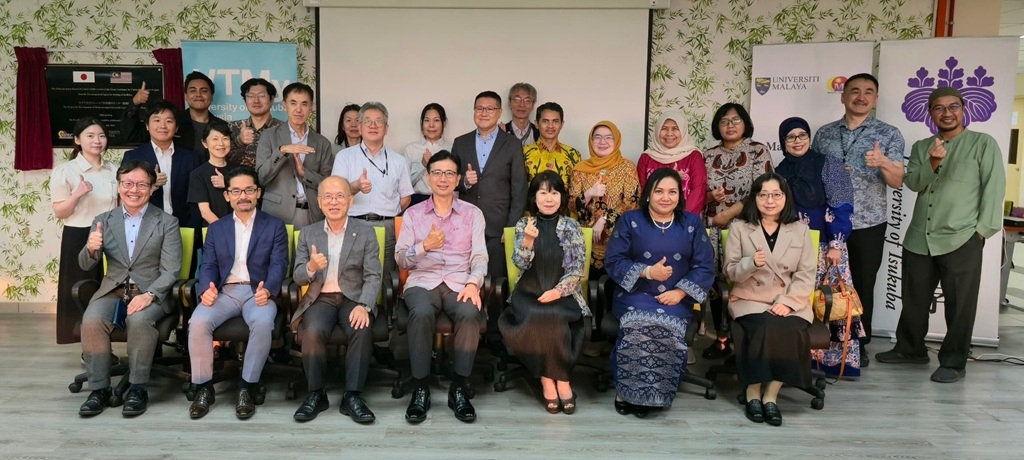
The first and second lectures in this series focused on science-related fields. For this third lecture, the series featured its first lecture in humanities, delivered by Professor HIRAISHI, whose area of expertise is comparative literature.
Under the title “Rethinking Japanese Studies from Southeast Asia: Comparison, Dialogue, and Cultural Understanding,” Professor HIRAISHI explained that studying Japan from Southeast Asia does not simply mean adding a regional perspective to Japanese Studies. Rather, it can provide an opportunity to reconsider what kinds of questions are asked in Japanese Studies and from what position those questions are posed.
Professor HIRAISHI described comparative literature not merely as the comparison of two works placed side by side, but as a method of “dialogue” through which meaning is created when different readers, histories, societies, languages, and cultural memories encounter one another.
In the lecture, she discussed examples including EKUNI Kaori’s short story “Melon,” MATSUMOTO Seicho’s Atsui Kinu (Hot Silk), ARISUGAWA Alice’s The Mystery of the Malayan Railway, Tan Twan Eng’s The Garden of Evening Mists, and the Webtoon version of the Indonesian female hero “Sri Asih”. Through these examples, she explained how literary works, places, and popular culture can acquire new meanings through encounters that cross national and regional boundaries.
Professor HIRAISHI also emphasized that Japanese Studies from Southeast Asia should be relational, viewing Japan not as an isolated cultural object but in the context of translation, movement, conflict, and shared histories. She noted that it should also be reflexive, by examining the assumptions of researchers and readers themselves; dialogic, by allowing perspectives from different positions to encounter one another; and productive, by recognizing Southeast Asia not simply as a recipient or market for Japanese culture, but as a place that generates knowledge and cultural forms capable of reshaping Japanese Studies itself.
During the Q&A session, participants exchanged views on issues such as how comparative literature can address nuances lost in translation, how to understand Malaysia’s multilingual literary context, and how to interpret pop-culture exchange and cultural co-creation between Japan and Malaysia.
EOJ plans to continue holding special lectures by various faculty members of UTMy under this series. Further information on the series will be made available on the website of EOJ.
Click here for an article on the first special lecture by Professor INAGAKI Toshiyuki, Chief Executive of the University of Tsukuba Malaysia.
Click here for an article on the second special lecture by Professor TSUJIMURA Maki, Professor of the University of Tsukuba and Dean of the School of Transdisciplinary Science and Design, UTMy.